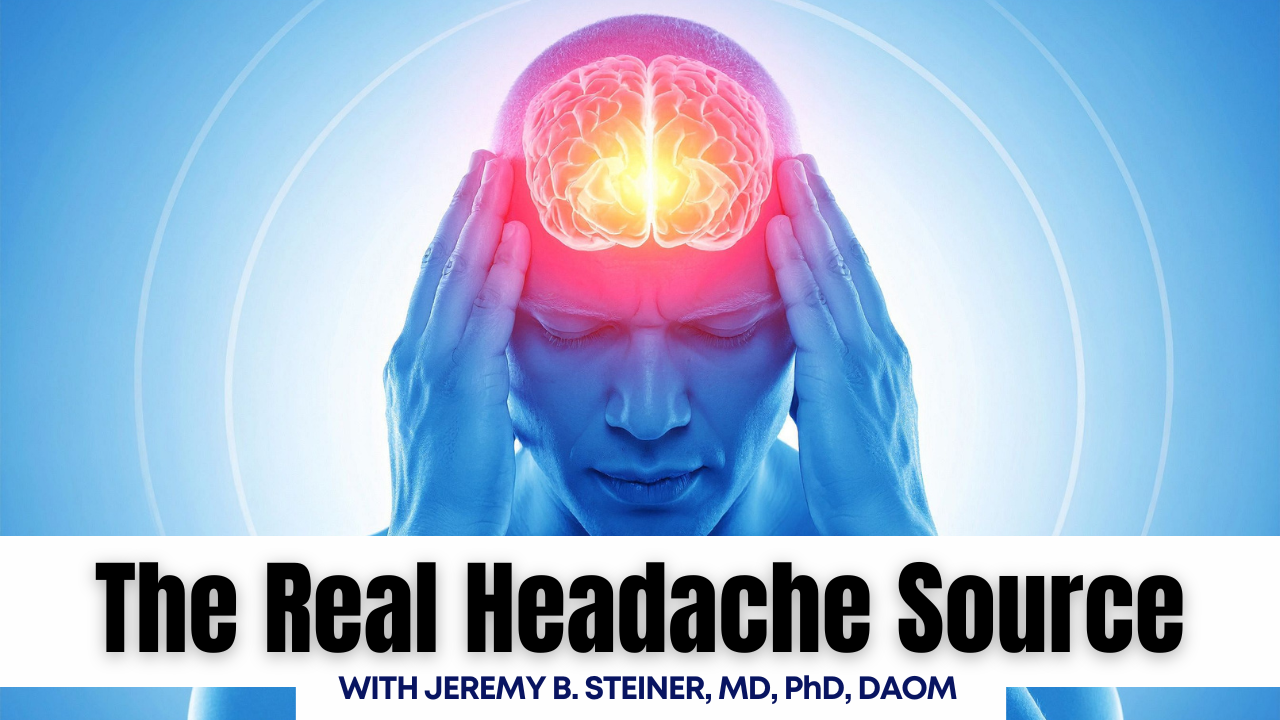
Temporal headaches tend to deceive even experienced practitioners. Because the pain sits so squarely in Gallbladder territory, it's easy to assume the Gallbladder channel is the primary cause. Week after week, patients will point to that familiar temple region, and we instinctively treat what we see. But when the same patient returns with little improvement—or the pain returns the moment they exert themselves—we realize something isn’t lining up.
This week’s training explores a case that demonstrates exactly why the Gallbladder diagnosis was only half right, and why the true source of temporal pain so often lies upstream. The body gave several clues, but the most important ones lived nowhere near the temple. They were found in channel relationships, missing wisdom teeth, and a deceptively simple shift of pain toward TE21.
Download the Free Resource: The 1–2–3 Diagnostic Shortcut for Temporal Headaches
Temporal pain can appear straightforward, but the body rarely expresses dysfunction in a single, isolated line. In the transcript case, the patient described a very particular pattern: pain at the temple that showed up after simply walking fifty steps and disappeared just as quickly when movement stopped. As the sensation intensified, it traveled toward the region just in front of TE21. This detail, almost thrown in casually, became the anchor for the entire diagnostic correction.
While it’s natural to jump toward the Gallbladder channel for any temple-related discomfort, this pattern behaved differently. It didn’t simply sit in the temporal region; it appeared with exertion, vanished with rest, and migrated toward a Fire-channel point. Those dynamics point to a channel lacking the voltage to maintain stability under load—something that doesn’t fit neatly within Gallbladder physiology.
The patient also shared that several wisdom teeth never developed. Missing teeth are more than anatomical footnotes; they are long-term energetic signatures. Wisdom teeth correspond to the Pericardium, Triple Energizer, Heart, and Small Intestine. When they never form, they signal that aspects of the Fire system may have begun life at a deficit, either genetically or via inherited field patterns. Even without dental symptoms, this creates a predisposition for Fire-related weaknesses that surface later in life.
The relationship between Fire and Wood becomes critical here. While practitioners readily remember that Liver and Gallbladder feed each other, they often overlook the deeper connections: the Pericardium feeds the Liver, and the Triple Energizer feeds the Gallbladder. When Fire struggles for a prolonged period, Wood cannot sustain its voltage. The Gallbladder then becomes the stage where the symptoms appear, even though it is not the original source of the problem.
The shift of pain toward TE21 was the giveaway. That area reveals the state of the Triple Energizer more clearly than words. Pain triggered by activity in this region reflects a TE deficiency expressing through the Wood system. The Gallbladder is simply the messenger. Once this becomes clear, the direction of treatment changes immediately.
To restore the system, the practitioner guided the patient toward supporting the Fire channels first—particularly by using microcurrent on TE5 and PC6 on the non-dominant arm. This approach not only strengthens the Triple Energizer and Pericardium but also drops the body into parasympathetic rest, temporarily sealing energy leaks and allowing genuine repair to occur. The simplicity of the technique belies its power; even a short window of uninterrupted healing makes a profound difference for a chronically drained Fire system.
The missing tooth connections help determine how to support the body further. If the tooth exists but never erupted, it may form a cavitation that drains the adrenals. If the tooth never existed, the cavitation concern disappears, but the developmental deficiency remains meaningful. Treating the corresponding body point helps remove the energetic drain that would otherwise prevent long-term improvement.
Only after the Fire channels regain strength can the Wood channels be treated effectively. Without this foundation, Wood remains unstable, and symptoms return. But once Fire is restored, the temporal headaches—previously persistent and exertion-triggered—resolve far more consistently.
The takeaway from this week’s training is simple: the Gallbladder may speak the loudest in temporal pain, but the Fire channels often speak the truth. When we learn to listen to the body’s quieter signals—shifts in pain location, developmental clues, and channel relationships—the diagnosis becomes clearer and the treatment far more transformative.
📥 Download The Free Practitioner Resource
Take the Next Step
Watch it on YouTube: https://youtu.be/7Vk65BXMPtg
Watch the full training and learn the terrain pain protocol step-by-step here: https://electroacupunctureinstitute.com/89
Stay curious, keep testing, and keep exploring the bridge between the body’s electrical and biological systems—because understanding that connection is where real healing begins.
Jeremy Steiner, MD, PhD, DAOM
Head Educator at The Electro Acupuncture Institute
For more great trainings go here: https://electroacupunctureinstitute.com/blog/